$ stat ./projects/juliet-cli.md
Title: Juliet-CLI
Date: 1/3/2026
Description: Juliet is a modular AI framework where independent isomorphic agents develop persistent, personalized intelligence via swappable adapters that inject structured, tagged context into a standardized prompt pipeline enabling plug-and-play, divergent learning without rigid orchestration.
(( Open on GitHub ))Juliet Framework and CLI
Junctive Unstructured Learning for Incrementally Evolving Transformers
Juliet is a modular AI framework where independent isomorphic agents develop persistent, personalized intelligence via swappable adapters that inject structured, tagged context into a standardized prompt pipeline enabling plug-and-play, divergent learning without rigid orchestration.
Each iso maintains its own persistent memory (via vector stores), facts, and task state, while continuously ingesting unstructured data from conversations, documents (.pdf, .txt, etc.), and other sources. Over time, isos fine-tune lightweight adapters against their unique experiential history, giving rise to distinct traits, behaviors, and emergent intelligence despite originating from a shared structural blueprint.
Juliet goes beyond conventional RAG pipelines. Rather than treating retrieval as a static augmentation step, the framework models learning as a dynamic process where memory, state-space evolution, and contextual perturbations interact and produce adaptive, creative, and increasingly individualized agents.
Project-level management with sandboxed workspaces
Dynamic Context System
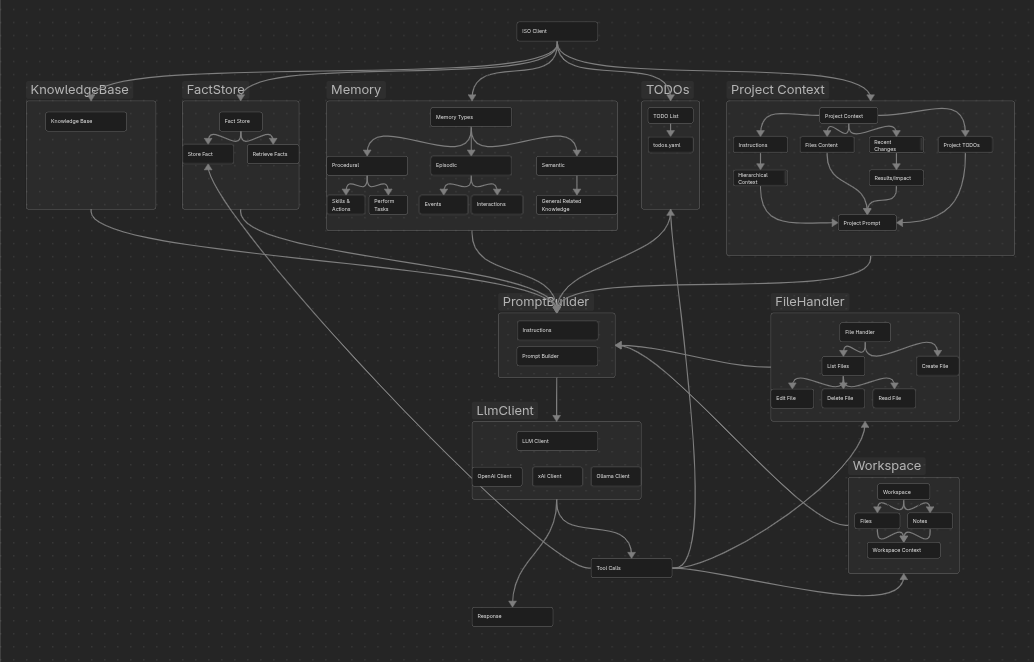
Juliet’s core is a dynamic, adapter-driven context pipeline designed for composability and long-term evolution.
-
Each context source (facts, memory, knowledge, history, etc.) is implemented as an independent adapter.
-
Adapters output a
List[dict]of standardized OpenAI-compatible messages (system,user,assistantonly). -
The prompt pipeline is assembled deterministically:
- System instructions
- Adapter outputs (stacked in configurable order)
- User request
- Assistant prefix for forced continuation
class ContextPipeline:
    def __init__(self, chroma_store: ChromaMemoryStore, message_cache: MessageCacheAdapter, iso_name: str, user_name: str):

        self.instructions = ModelInstructions(method="load", assistant_name=iso_name)
        self.adapters = OrderedDict()
        self.chroma_path = f"isos/{iso_name.lower().strip()}/users/{user_name.lower().strip()}/chroma_store"
        self.semantic_memory_path = f"isos/{iso_name.lower().strip()}/users/{user_name.lower().strip()}/semantic_memory.json"
        self.episodic_memory_path = f"isos/{iso_name.lower().strip()}/users/{user_name.lower().strip()}/episodic_memory.json"
        self.facts_memory_path = f"isos/{iso_name.lower().strip()}/users/{user_name.lower().strip()}/facts_memory.json"

        # === Register Context Adapters === #
        self.register_adapter("timestamp", TimestampAdapter())
        self.register_adapter("semantic", SemanticMemoryAdapter(chroma_store=chroma_store))
        self.register_adapter("episodic", EpisodicMemoryAdapter(chroma_store=chroma_store))
        # TODO: self.register_adapter("procedural", ProceduralMemoryAdapter(chroma_store=chroma_store))
        # TODO: self.register_adapter("facts", FactStoreAdapter(chroma_store=chroma_store))
        self.register_adapter("message_cache", message_cache)
        self.register_adapter("user_request", UserRequestAdapter(tag_name="user"))
        self.register_adapter("assistant_prefix", AssistantPrefixAdapter(prefix="<assistant>"))

    def register_adapter(self, name: str, adapter: BaseContextAdapter):
        self.adapters[name] = adapter

    def build_messages(self, user_request: str) -> List[Dict[str, str]]:
        """
        Build the full message list by combining fixed instructions and all adapters.
        Adapters that require the current user query receive it; others do not.
        """
        messages = [
            {"role": "system", "content": f"<system>{self.instructions.system_message}</system>"},
            {"role": "assistant", "content": f"<assistant_intro>{self.instructions.assistant_intro}</assistant_intro>"},
            {"role": "system", "content": f"<focus>{self.instructions.assistant_focus}</focus>"},
        ]

        for adapter in self.adapters.values():
            if adapter.requires_user_request:
                msgs = adapter.build_messages(user_request=user_request)
            else:
                msgs = adapter.build_messages()
            if msgs:
                messages.extend(msgs)

        return messages
To preserve semantic boundaries and guide model reasoning, adapter content is compartmentalized using XML-like tags (e.g. <facts>, <memory>, <knowledge>). For example:
<semantic>
  <The_Adventures_Of_Sherlock_Holmes>
    Relevant passages from The Adventures of Sherlock Holmes...
  </The_Adventures_Of_Sherlock_Holmes>
  <Attention_Is_All_You_Need>
    Relevant passages from the Attention is All You Need paper...
  </Attention_Is_All_You_Need>
</semantic>
Summary: Highly modular, swappable context injection with a strict message format and tagged structure optimized for clarity, control, and emergent learning.
TUI Interface for a Dynamic Learning Framework
Juliet includes a terminal-based interface designed to make agent evolution observable and hands-on:
- Agent-centric contextual views
- Modularity-first, plug-and-play adapter architecture
- Feed-forward prompt construction
- Recursive tool calling
- Model workspace with full CRUD file access
- ChromaDB-backed vector memory
- YAML-driven instructions, configuration, and history
$ grep -r "related" ./projects/
Finding related projects...
$ cd .. && ./projects.sh
← Back to all projects